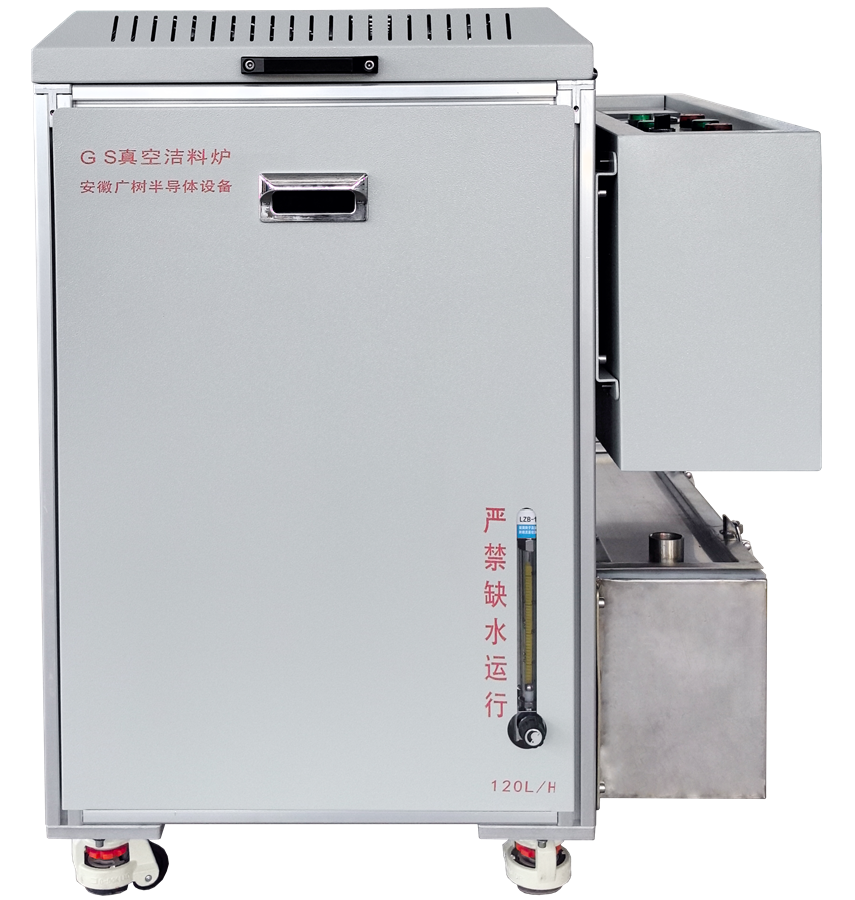
Vacuum cleaning furnace
The vacuum cleaning furnace removes polymer residue from extrusion dies and screws by pyrolysis instead of solvents or caustic baths. No chemicals, no wastewater, and no abrasion or etching of the tool surface. Delivered GSQ units run at up to 650 °C.
Also called vacuum pyrolysis cleaning furnace · extrusion die cleaning furnace · mold cleaning furnace · polymer removal oven
Three things that decide the specification
Each of these changes the final configuration — this is not general boilerplate.
The vacuum is there to stop oxidation, not just to make an atmosphere
An extrusion die works on a polished surface. At pyrolysis temperature, oxygen in the chamber grows an oxide layer, and a polished face that has dulled must be re-ground — the cleaning time you saved is lost in re-finishing. Under vacuum the polymer leaves by pyrolysis while the die surface never sees oxygen.
The temperature ceiling comes from the die steel, not from the furnace
Common extrusion die steels (H13 / SKD61 class) are tempered around the 550–600 °C band. Run the cleaning cycle past that and the die starts to lose hardness and dimensional stability, irreversibly. The question at specification time is not how hot the furnace can get, but which temperature will be used on your dies.
Define "clean" before the first cycle, or every batch becomes an argument
Pyrolysis removes organic polymer; it does not remove inorganic fillers. Glass fibre, mineral fillers and metal oxides remain as an ash-like residue. So fix the acceptance criterion before the first cycle — residual mass after a blank run, first-article appearance, or residual carbon. "It looks clean" is not a criterion and will not survive a material change.
Delivered vacuum cleaning furnace systems
Open any system for its full specification and provenance.
Frequently asked
Can it clean screws as well as dies?
Both, but the acceptance criterion differs. A die has open flow channels, so residue after pyrolysis is low and easy to judge. A screw has deep, partly shadowed flights, so rack position affects how evenly it heats and it usually needs a longer soak. State the compound as well: glass-fibre or mineral-filled material leaves an inorganic residue that pyrolysis cannot remove, and which still needs manual work afterwards.
How long is a cycle, and how does it compare with chemical cleaning?
Cycle length depends on the polymer, the load and the chamber size — it is worked out per application rather than quoted as one number, and we do not print figures we have not measured on delivered units. Against chemical cleaning, compare three items: the recurring cost of chemicals and wastewater disposal, the risk of damage to a polished face, and downtime. Pyrolysis removes the first two; the trade is a longer single cycle and the need to exhaust the released volatiles — something that has to be settled at specification stage, or they recondense inside and contaminate the chamber.
Other furnace types
Tell us your process conditions
Temperature, atmosphere, material and part size are enough for us to suggest a furnace type and draft a proposal.