Tube furnace
A tube furnace confines the workload inside a single tube, which makes atmosphere control easy to keep clean and lets it heat quickly. It suits small samples, continuous pass-through processes and experiments needing precise atmosphere.
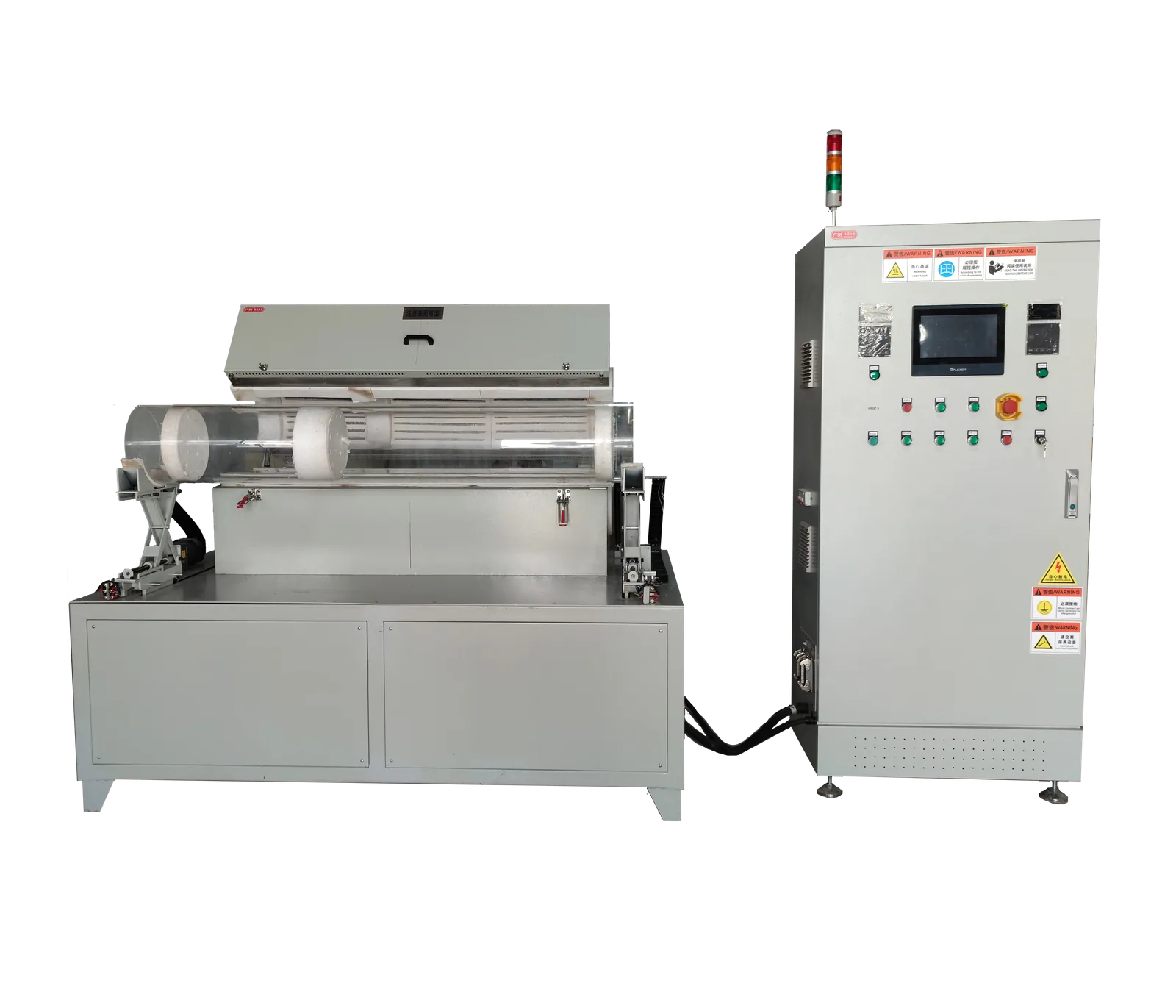
Also called vacuum tube furnace · atmosphere tube furnace · quartz tube furnace
Three things that decide the specification
Each of these changes the final configuration — this is not general boilerplate.
Tube material follows temperature and atmosphere
Quartz suits service below 1200 °C where purity matters; alumina tubes reach 1600 °C but tolerate thermal shock poorly; metal tubes (310S, Inconel) resist shock and take more pressure but react with some atmospheres. A wrong tube choice often fails on the very first ramp.
Bore diameter trades load capacity against zone length
A larger bore takes more sample but shortens the relative constant zone and slows the ramp. GSG-40-1100 uses a φ40 mm tube with a 350 mm heated zone and reaches temperature in 30 minutes empty — the narrow bore buys speed and uniformity.
For pass-through duty, the end seals decide everything
For pass-through duty the seals at both ends must open and close with a gas curtain, otherwise every load breaks the atmosphere. This is normally engineered per process rather than taken from a standard model.
Delivered tube furnace systems
Open any system for its full specification and provenance.
Frequently asked
Can a tube furnace pull vacuum?
Yes, but the level matters. A quartz tube with a mechanical pump reaches the 10⁻¹ Pa range; with a turbo pump set, the 10⁻⁴ range (GSG-Q-1200 is rated below 9×10⁻⁴ Pa for the pump set). The limit is usually the end seals and the tube itself, not the pump.
Horizontal or vertical?
Horizontal is easier to load and suits long samples and pass-through processes; vertical saves floor space and suits work where the sample or melt must hang or drip freely, such as fiber drawing. Decide by the process motion, not by available space.
Other furnace types
Tell us your process conditions
Temperature, atmosphere, material and part size are enough for us to suggest a furnace type and draft a proposal.