Glass lens annealing furnace
The glass lens annealing furnace succeeds or fails on the cooling curve, not the ramp up. Cooling too fast above the annealing point leaves residual stress in the glass, which appears later as refractive index drift, figure change or cracking. Delivered GSK units cover 650–700 °C, with uniformity specified per chamber and loading — up to ±3 °C by 9-point measurement across the constant-temperature zone.
Also called aspherical lens annealing furnace · precision annealing furnace for optical lenses · optical glass annealing furnace · molded lens annealing furnace
Three things that decide the specification
Each of these changes the final configuration — this is not general boilerplate.
Cap the cooling rate — it decides index drift and figure change
Above the annealing point glass is still plastic, and the cooling rate through that band is written into the residual stress. Natural cooling is non-linear: it is usually too fast exactly across the critical stress-relief band. Delivered units treat the cooling rate as a setpoint: GSK-40-700Y was specified at a maximum of 80 °C/h above 350 °C, and GSK-80-750 at ≥50 °C/h above 350 °C, freely adjustable.
Uniformity is a yield figure, not a convenience feature
Poor uniformity means lenses at different positions in the same batch anneal differently — that is yield loss, not a minor inconvenience. Uniformity was specified per chamber and per loading: the tightest unit, GSK-80-750, holds ±3 °C across the constant-temperature zone by 9-point measurement, and GSK-65-600 was accepted at ±5 °C. Uniformity degrades under load and depends heavily on how the load is arranged.
How you load decides both uniformity and cost per lens
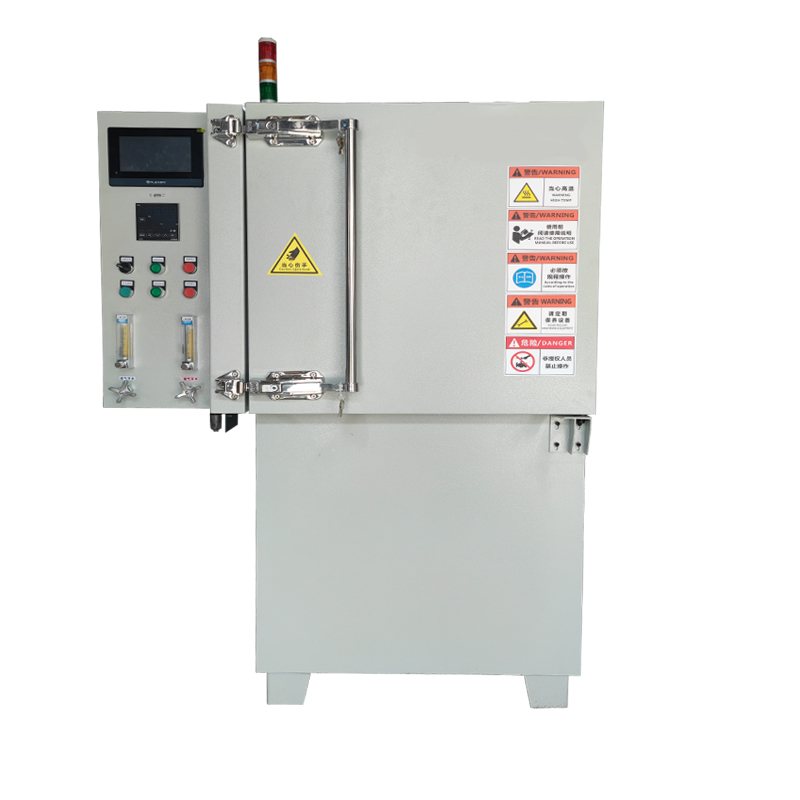
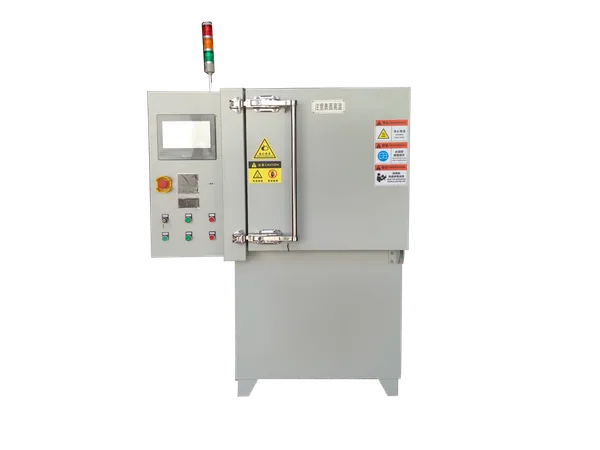
Multi-layer heat-resistant stainless shelves with an internal high-temperature circulation fan: the circulation duct is precision-welded 310S alloy stainless (GSK-65-600, 370 W fan), which evens the field far better than radiant heating alone and cuts drift. Pull-out shelves raise the load per cycle, which lowers the furnace time charged to each lens. Delivered units cover both arrangements: three pull-out layers on GSK-80-750, and a fixed six-layer rack at 65 mm pitch on GSK-Q-700.
Delivered glass lens annealing furnace systems
Open any system for its full specification and provenance.
Frequently asked
What uniformity can you commit to?
In delivered projects the tightest requirement was ±3 °C (GSK-80-750, 9-point measurement across the constant-temperature zone); another unit (GSK-65-600) was accepted at ±5 °C. What is achievable depends on chamber size, temperature band and loading — larger chambers and denser loads make it harder. We do not commit to figures we cannot meet: if the assessment says no, we say so during the proposal stage rather than promising first and explaining later.
Does the furnace need a controlled atmosphere?
Most optical glass annealing runs in ambient air — the thermal path decides the result, not oxidation. An inert/reducing atmosphere is for two other cases: the glass itself is atmosphere-sensitive, or the mold or carrier material oxidises in that band. One of the four delivered GSK units (GSK-Q-700) is fitted for inert/reducing atmosphere; the other three run in air. Specify by process, not by "more options must be safer".
Other furnace types
Tell us your process conditions
Temperature, atmosphere, material and part size are enough for us to suggest a furnace type and draft a proposal.